
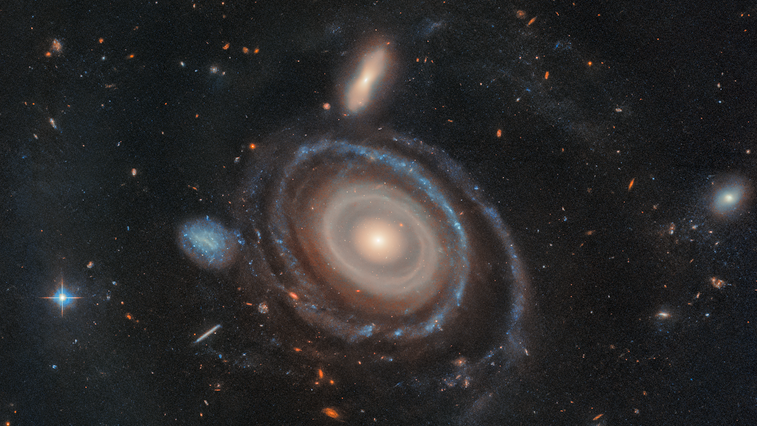
Hubble Spots a Stunning ‘Bullseye’ in Deep Space
The Hubble Space Telescope has captured an extraordinary Einstein Ring, a glowing bullseye-like formation in deep space. This rare and visually striking cosmic structure is formed due to gravitational lensing, a phenomenon first predicted by Albert Einstein’s General Theory of Relativity.
What is an Einstein Ring?
An Einstein Ring occurs when the light from a distant galaxy is bent around a massive foreground galaxy due to its strong gravitational field. This effect magnifies and distorts the background galaxy’s light, forming a near-perfect circle, resembling a cosmic bullseye.
Why is This Important?
-
Natural Telescope: The magnification effect allows astronomers to study extremely distant and faint galaxies that would otherwise be invisible.
-
Dark Matter Insights: The way light bends helps scientists map dark matter, the invisible substance making up most of the universe’s mass.
-
Galaxy Evolution: Observing these lensed galaxies provides clues about how galaxies formed in the early universe.
Hubble’s Role in the Discovery
Thanks to Hubble’s powerful optics and precision, scientists can study the fine details of Einstein Rings. This newly spotted bullseye structure is a remarkable example of how cosmic forces shape the universe in ways that are both scientifically significant and visually mesmerizing.
In a breathtaking discovery, the Hubble Space Telescope has captured an astonishing bullseye-shaped phenomenon in the vastness of deep space. This rare celestial formation, known as an Einstein Ring, is a perfect cosmic illusion formed by the bending of light around an unseen gravitational force.
The Science Behind the Cosmic Bullseye
The image, resembling a glowing halo, is created by an effect called gravitational lensing. When a massive foreground galaxy sits directly between Earth and a more distant galaxy, its gravitational field acts like a cosmic magnifying glass—bending, distorting, and magnifying the distant light into a circular shape. This discovery confirms one of Einstein’s most fascinating predictions about the nature of gravity and space-time.
Why This Discovery Matters
-
Unlocking the Secrets of the Early Universe – The magnified light allows scientists to study galaxies billions of light-years away, offering glimpses into the universe’s infancy.
-
Mapping the Invisible – The way the light bends provides crucial insights into the presence of dark matter, the unseen force shaping galaxies and cosmic structures.
-
A Natural Cosmic Telescope – This effect enables astronomers to observe distant galaxies in unprecedented detail, revealing clues about their formation and evolution.
A Cosmic Work of Art
Beyond its scientific significance, this newly captured Einstein Ring is a stunning visual masterpiece—a reminder of the hidden wonders woven into the fabric of the universe. As Hubble continues to peer into the depths of space, it unveils the mysteries of time, gravity, and cosmic evolution, offering humanity a deeper connection to the vast and awe-inspiring cosmos


0 Comments